Sunday, 14 August 2016

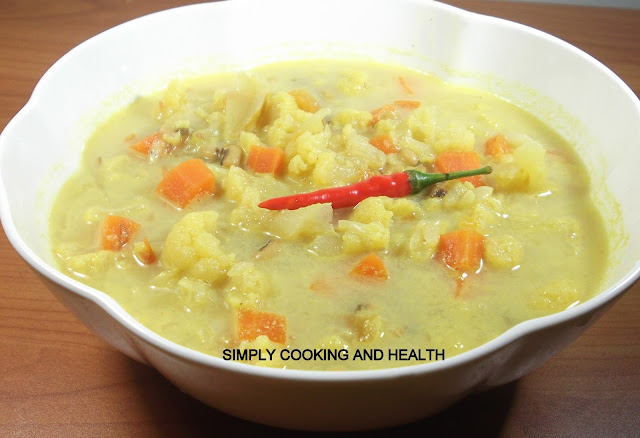
Mild Cauliflower stew with black eyed beans in coconut milk

Mild Cauliflower stew with black eyed beans in coconut milk
Mild  Cauliflower stew with  black eyed beans in coconut milk


Cauliflower is a healthy vegetable. Low carbohydrate dieters can use it as a substitute for potatoes or rice because it has a similar texture and taste.
It contains many vitamins such as Thiamine (B1), Riboflavin (B2), Niacin (B3), Pantothenic acid (B5), Vitamin B6, Folate (B9), Vitamin C, Vitamin E, Vitamin K. It contains many vitamins such as Thiamine (B1), Riboflavin (B2), Niacin (B3), Pantothenic acid (B5), Vitamin B6, Folate (B9), Vitamin C, Vitamin E, Vitamin K.
It also contributes many trace minerals such as Calcium, Iron, Magnesium, Manganese, Phosphorus, Potassium, Sodium and Zinc.
It helps to fight cancer and inflammation and it supports detoxification.

Cauliflower can be roasted, boiled, fried, steamed, or eaten raw.

Today I am going to make a stew.


                                     Recipe summary
                                              For 
 Mild Cauliflower stew with black eyed beans in coconut milk    

Preparation time: 15 minutes
Cooking time:30 minutes

Serves: 4                                      

1. Soak 180 grams dried black eye beans overnight. Drain in a colander and boil in a pan of water till it is done. You can cook ahead and leave in the refrigerator.
Mild Cauliflower stew with black eyed beans in coconut milk
Mild  Cauliflower stew with 
black eyed beans in coconut milk


2. In a large pan heat 2 tbsp oil. When the oil is hot reduce the heat to low add 1 dry chili, whole and fry for 10 seconds.

3. Add 3 cloves garlic, sliced and 75 grams onions, coarsely chopped and fry for 3 minutes.

4. Add ½ tsp cumin seeds and ½ tsp fennel seeds and fry for 10 seconds.

5. Add 100 grams tomato, cut into bite size pieces and fry for 3 minutes.
Ingredients

6. Add 500 grams cauliflower, cut into small flowerets of equal sizes and fry for 3 minutes.

7. Add 150 grams carrot, cut into bite size pieces and ½ tsp turmeric powder, add 300 grams boiled beans, 10 grams ginger, grated and fry for 3 minutes.

8. Add 2 cups water and ½ tsp salt and cover and simmer for 15 minutes or till the beans and cauliflower become soft and according to your taste.

9 Add ¾ cup coconut milk and cook for 3 minutes.
Taste for seasoning and adjust.

Mild Cauliflower stew with black eyed beans in coconut milk
is ready.

                      Recipe  follows in detail with pictures.

Preparation time: 15 minutes
Cooking time:30 minutes
Serves: 4

Ingredients
Main
500 grams cauliflower, cut into small flowerets of equal size.
300 grams black eye beans
150 grams carrot, cut into bite size pieces
100 grams tomato, cut into bite size pieces

Others
75 grams onions, coarsely chopped
3 cloves garlic, sliced
10 grams ginger, grated
¾ cup Coconut milk
1 dry chili, whole
½ tsp salt
2 tbsp vegetable oil
Water 2 cups

Spices
½ tsp cumin
½ tsp fennel seeds
½ tsp turmeric powder


Ingredients for Mild Cauliflower stew with black eyed beans in coconut milk
Ingredients for Mild Cauliflower stew with black eyed beans in coconut milk

Preparation
Soak black eye beans overnight. Drain in a colander and boil in a pan of water till it is done. You can cook ahead and leave in the refrigerator.

Method
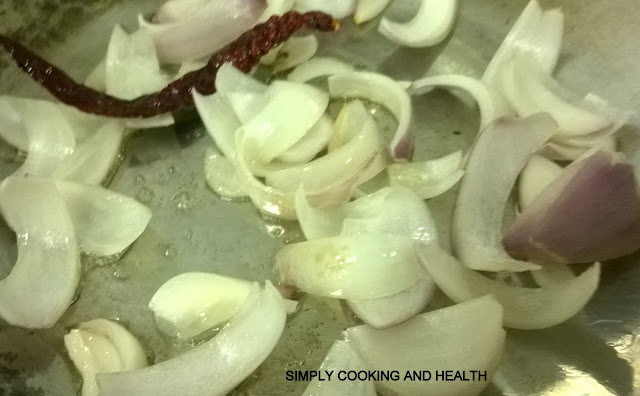
In a large pan a heat 2 tbsp oil. When the oil is hot reduce the heat to low add dry chili and fry for 10 seconds.
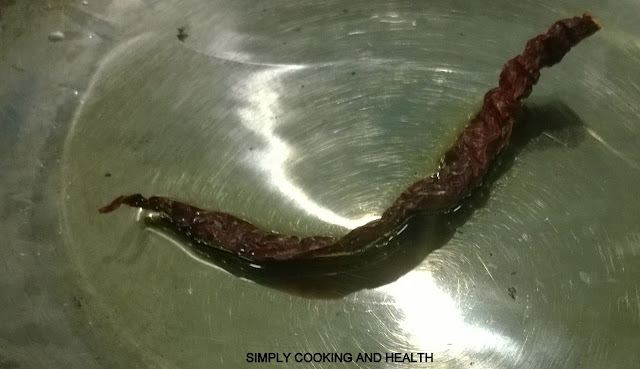
Frying dry chili
Frying dry chili

Then add onion and fry for 5 minutes. 

Adding onions
Adding onions
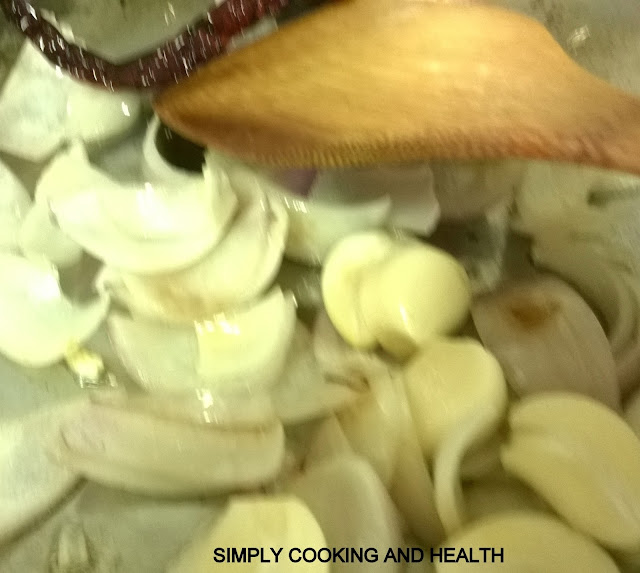
Add garlic and fry for 3 minutes.
Adding garlic
Adding garlic

Add cumin seeds and fennel seeds and fry for 10 seconds.


Adding cumin
Adding cumin and fennel seeds

Add tomato pieces and fry for 3 minutes.
Adding tomato
Adding tomato

Add cauliflower pieces and fry for 3 minutes.
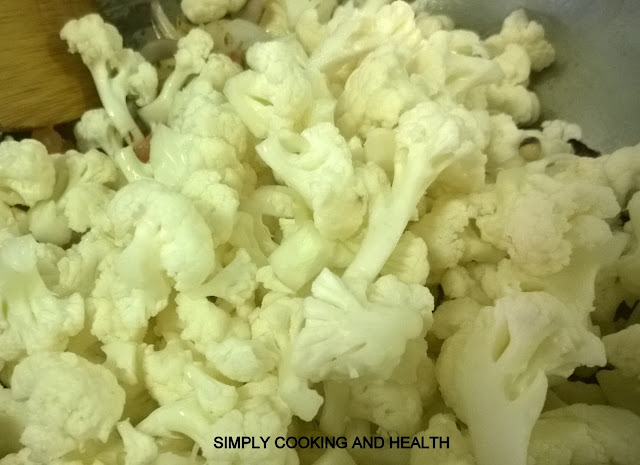
Adding cauliflower
Adding cauliflower

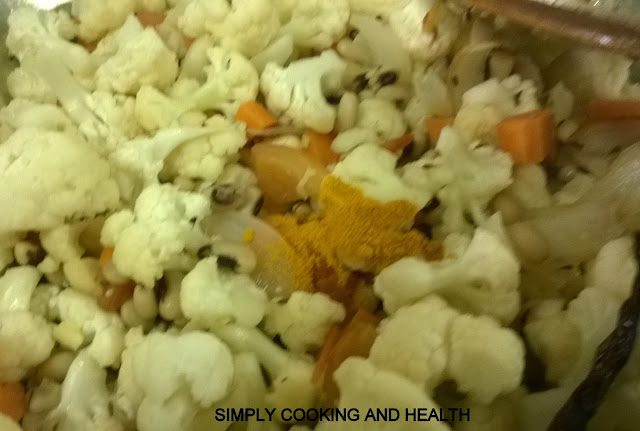
Add carrot and turmeric


Adding carrot and Turmeric

Add boiled beans, ginger and fry for 3 minutes.
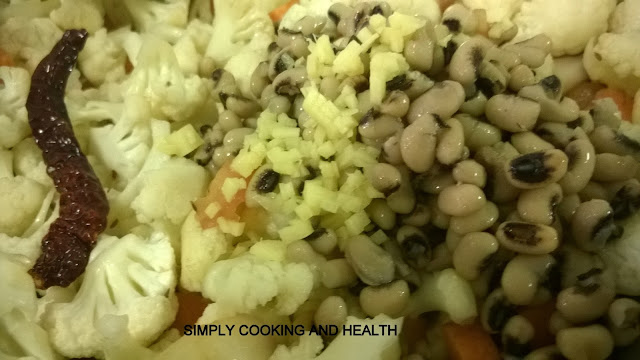
Adding boiled beans,garlic and ginger


Add water, and salt cover and simmer for 15 minutes or till the beans and cauliflower become soft and according to your taste.
Adding water
Adding water

Add coconut milk and cook for 3 minutes.
Adding coconut milk
Adding coconut milk

Taste for seasoning and adjust.

The stew is ready.

The stew and fried tempeh


You may like this
Cauliflower stir-fry with turmeric


Stir fried steamed couscous with roasted white rice flour (puttu)


Stir fried steamed couscous with roasted white rice flour (puttu)

I have given my recipe for steamed couscous with rice flour (puttu).
This recipe is to make the couscous puttu even more tastier by stir-frying it with other ingredients.


                                      Recipe summary
                                               For 
       Stir fried steamed couscous with roasted white rice flour 


Preparation time: 25 minutes
Cooking time: 30 minutes
Serves: 6

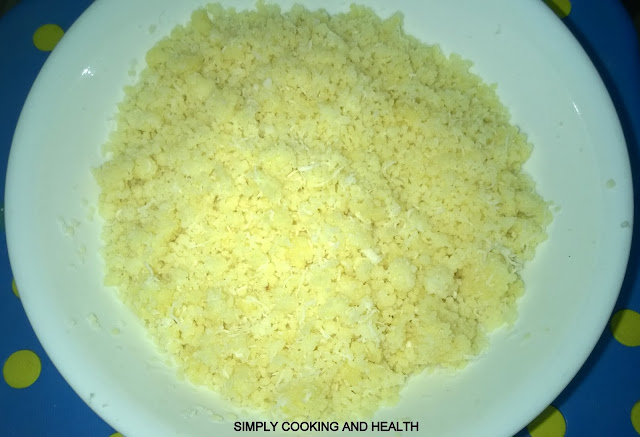
1. Prepare the couscous as given in my recipe http://simplycookingandhealth.blogspot.com/2015/07/ steamed-couscous-with-kale-and-grated coconut.html.
Stir fried steamed couscous with
roasted white rice flour (puttu)


2. Beat 4 eggs with  0.3 gram (1/8 tsp) pepper powder and 1/4 tsp salt and set aside.

3. Fry 5 slices ham – cut or broken into small pieces slightly in a frying pan and cut into small pieces.

4. Cook 2 slice hash brown - Crumble into small pieces for 3 minutes high in micro wave. 

5. In a large frying pan or wok add 3 tbsp vegetable oil and heat it. 

6. When the oil is hot add 1/4 tsp cumin seeds and reduce the heat to low and fry for about 10 seconds. 

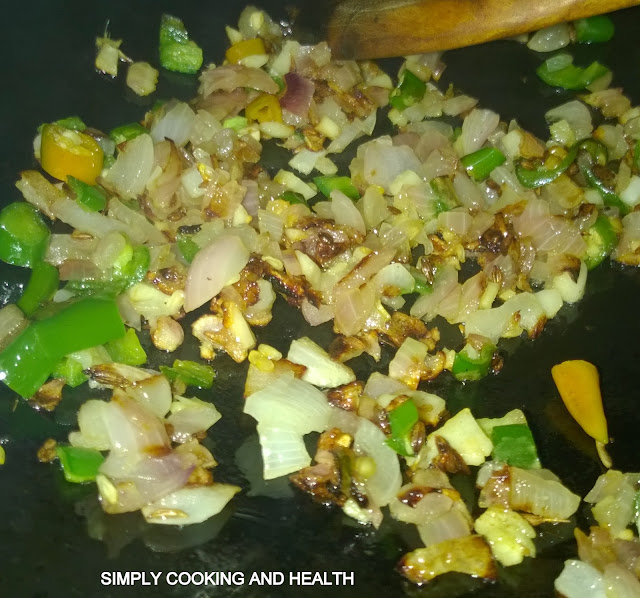
7. Add the 150 grams large onion - chopped and fry for about 10 minutes. Stir frequently to prevent onion from burning.

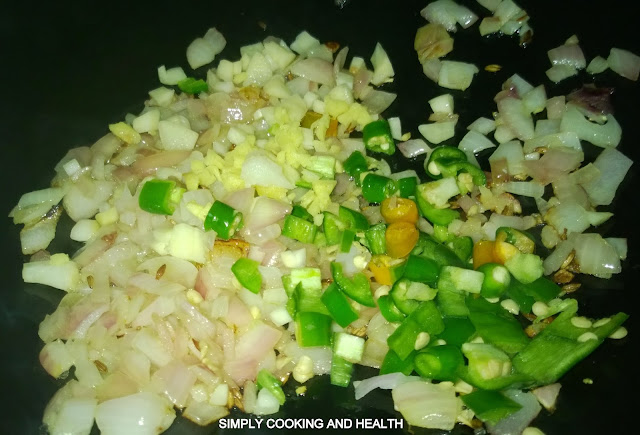
8. Add 1 green chili,sliced thin, 10 grams ginger, grated, and 9 grams garlic,sliced and fry for about 2 minutes. Fry onion till it becomes brown.
Ingredients

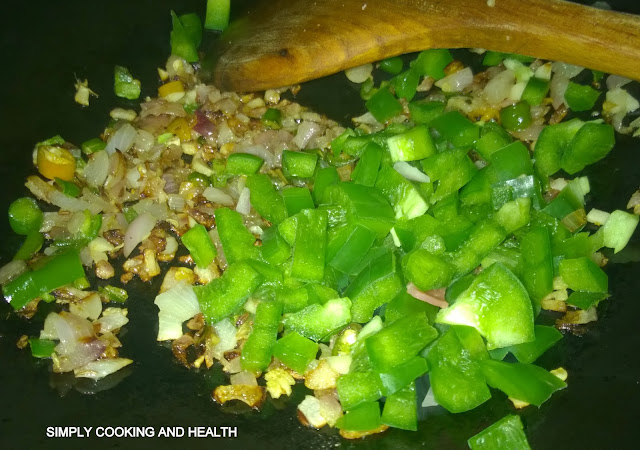
9. Add 100 grams (1/2) green bell pepper (Medium), cut into small pieces. 

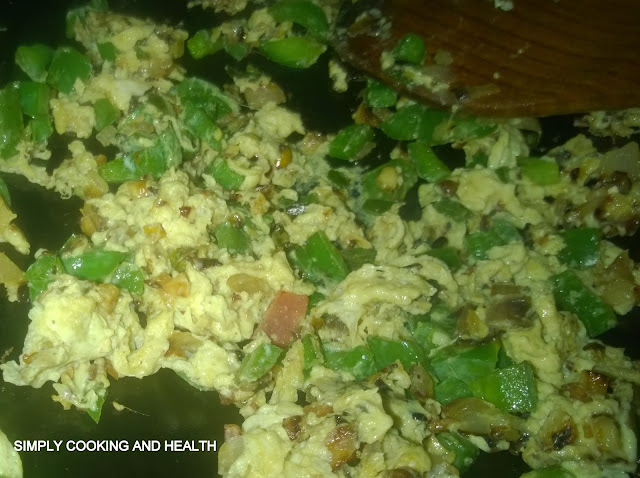
10. Make a well in the centre of the pan or wok to pour the beaten eggs. Stir well, while breaking the egg into small lumps and  scramble the eggs. The eggs will be cooked in about 3 minutes.

11. Now add the broken ham pieces and the pieces of hash brown and stir well for about 30 seconds.


12. Take about 300 grams of steamed couscous with rice flour and add to the fried items..


13. Stir well to mix all ingredients and cook for about one minute.


Stir fried steamed couscous with roasted white rice flour (puttu)
is ready.
               Recipe follows in detail with pictures.


Preparation time: 25 minutes
Cooking time: 30 minutes
Serves: 6

Ingredients
Main
500 grams Steamed couscous
2 cups roasted rice flour 

Others
5 slices ham – cut or broken into small pieces
2 slice hash brown - cut or broken into small pieces
4 eggs
150 grams large onion - chopped
100 grams (1/2) green bell pepper (Medium) – cut into small pieces
10 grams ginger - grated
9 grams garlic - sliced
15 grams green chili – sliced thin
0.5 gram (1/4 tsp) cumin seeds


Ingredients for Stir fried steamed couscous with roasted white rice flour (puttu)
Ingredients for Stir fried steamed couscous with roasted white rice flour (puttu)
2.5 grams (½ tsp) salt
37.8 grams (3 tbsp) vegetable oil
240 grams (four) eggs
0.3 gram (1/8 tsp) pepper powder
1.25 gram (1/4 tsp) salt


Preparation

Prepare the couscous as given in my recipe http://simplycookingandhealth.blogspot.com/2015/07/ steamed-couscous-with-kale-and-grated.htmle.
Stir fried steamed couscous with roasted white rice flour (puttu)

Beat the eggs with pepper and salt and set aside


Fry ham slightly in a frying pan and cut into small pieces
Fried ham
Fried ham

Cook hash brown for 3 minutes high in micro wave. Crumble into small pieces
Hash brown
Hash brown


Method

In a large frying pan or wok add the oil and heat it. 

When the oil is hot add the cumin seeds and reduce the heat to low and fry for about 10 seconds. 
Frying cumin seeds
                                            Frying cumin seeds Add the onion and fry for about 10 minutes. Stir frequently to prevent onion from burning.
Addding onion
adding onion

Add green chili, ginger and garlic and fry for about 2 minutes.
Adding chili, garlic ginger and bell pepper
Adding chili, garlic ginger and bell pepper fry onion till becomes brown
Onion is fried well
Onion is fried well
Add bell pepper

Adding bell pepper
Adding bell pepper
Make a well in the centre of the pan or wok to pour the egg
Pouring the beaten egg

 Stir well, while breaking the egg into small lumps – like scrambled. The egg will be cooked in about 3 minutes.


Scrambled egg
Scrambled egg


Now add the broken ham pieces
Ham is being added
Ham is being added

Now add the pieces of hash brown Stir well for about 30 seconds.
Hash brown is being added


Egg ham and hash brown mixture is ready
Egg ham  and hash brown mixture is ready 


Then add the steamed couscous with rice flour.
steamed couscous is added

Stir well to mix all ingredients and cook for about one minute.

The stir-fried puttu is ready. 
Steamed couscous with other ingredients are mixed well
This is a one meal dish.

This is a very tasty dish
Stir fried steamed couscous with roasted white rice flour (puttu)


Steamed couscous with kale omelet and coconut sambol


Thursday, 11 August 2016

Children’s Food Allergy

Food allergy among children is very common. One in 20 children get food allergy whereas only 1 in 50 adults have food allergy. The most common allergenic are egg, cow's milk, peanut, tree nuts, seafood, sesame, soy, fish and wheat. Majority of food allergies in children are not severe. Probably the will outgrow the allergy with time. But some may remain lifelong allergies. However, peanut, tree nut, seed and seafood allergies are less likely to be outgrown.

When an allergenic enters the body, the system secretes histamine to protect the body. This histamine caused the symptom to appear and is treated with anti- histamine.

Mild to moderate allergy may show up in swelling of face, lips and/or eyes, hives or welts on the skin, abdominal pain and vomiting.

Symptoms of severe allergy include: breathing difficulty, swelling of tongue or throat, wheezing or persistent cough and dizziness.

People sometimes confuse food allergies with food intolerance because their similarity in symptoms. The symptoms of food intolerance can include burping, indigestion, gas, loose stools, headaches and nervousness. But food intolerance doesn't involve the immune system. It may be caused by a person's inability to digest certain substances, such as lactose. Food intolerance can be unpleasant but is rarely dangerous.

Peanut allergy is very common in the United States but unheard of in rural Africa. This is because parents avoid giving peanut to their children fearing allergy. Recent studies show that avoiding foods of all types of foods increases the risk of baby’s allergy to the food.

Current treatment for these food allergies is based on desensitization. This is done by giving the child a measured amount of allergen at regular intervals and increasing the dosage gradually to increase the threshold of reaction. Desensitization is not a cure because in some children when you stop giving them the allergen for a period of time they will go back to their original threshold of tolerance.
A study done in Royal Children’s Hospital in Melbourne suggested that addition of  probiotics increased the safety and effectiveness of desensitization.

If you suspect your baby having an allergy consult a doctor. The doctor will perform a blood test or a ‘skin prick’ test to ascertain the allergy. Once you have confirmed the allergy you may avoid the allergen altogether and wait to see if the child outgrows the allergy. Other alternative is to talk to you doctor about a safe desensitization program along with some probiotics. Probiotics strengthen the immune system.

Monday, 8 August 2016

Prostate enlargement


Prostate is walnut sized gland that wraps around the tube that carries urine from the bladder. Prostate is a part of the male reproductive system. It secretes fluid that nourishes and protect the sperm. The fluid excreted by the prostate makes up about one-third of the of the semen by volume. It contains various enzymes, zinc and citric acid.

More than half the men over 70 have a benign growth in the prostrate or enlargement of the prostate. Frequent urination,dribing or leaking urine may indicate a prostrate problem. Growing prostrate can also indicate a prostrate cancer. Initially a doctor may do a digital rectal examination to find any hard lumps that may be indicative of a cancer. Ultra sound machines are also used to image the prostrate and assess its actual size. Prostate specific antigen blood test will also reveal suspected prostrate cancer.

Measuring the flow of urine may reveal a prostate problem. Cysytoscopy is another method of diagnosing a prostate problem. A thin tube with a lens is inserted into the bladder through urethra. The doctor looks at the prostate through this lens to ascertain any problem.

New drugs are available to shrink or relax the prostate to keep it from blocking the bladder opening. A controlled laser beam inside the prostate can be used to destroy excess prostate tissue interfering with the exit of urine from the body. An incision may be made in the urethra to widen it to allow urine to be passed easily. Trans-urethral microwave thermotherapy may be used to destroy prostate tissues. Electromagnetically generated heat by using a needle-like device in the urethra may be used to destroy excess prostate tissue.

For prostate enlargement exercise the pelvic muscles to strengthen them. Aerobic exercise also will also help. Some people take Epsom salt bath to cure prostate enlargement. This done by alternating hot and cold baths 2 or more times a day and for two or three days a week. In Europe people used stinging nettle root to treat prostate enlargement. Apple cider vinegar is also consumed to alleviate the symptoms of prostate enlargement. Avoid alcohol and caffeine.

Ayurveda recommends consuming squashes that are white inside. Asparagus and daikon are good. Including black pepper, long pepper and ginger is advised.

Thursday, 4 August 2016

Spicy sweet and sour Butternut squash salad

Spicy sweet and sour Butternut squash salad
Butternut squash (Cucurbita moschata) is known in Australia and New Zealand as butternut pumpkin or gramma, and "Batana" in Sri Lanka. It has a sweet, nutty taste similar to that of a pumpkin. It has yellow skin and orange fleshy pulp. It is available in the market all the year round.
 Butternut squash
 Butternut squash 
Butternut squash has many vital poly-phenolic anti-oxidants and vitamins. It has more vitamin A than that of in pumpkin..It is cooked like pumpkin. Today I am going to make a very simple salad using it.


                                    Recipe summary
                                             For
                  Spicy sweet and sour Butternut squash salad

Preparation time: 20 minutes
Cooking time: 10 minutes

Serves: 4

1. Wash, peel 130 grams butternut pumpkin and remove the seeds.

2. Cut the vegetable into ¼ inch or ½ inch cubes. 
Spicy sweet and sour Butternut squash salad
Spicy sweet and sour Butternut 
squash salad

In a medium sized steamer add the squash pieces and steam them for about  ten minutes. Set aside to cool.

3. Mash the steamed squash  well. I used the hand held blender to mash.

Mix all the ingredients: 100 gram onion chopped fine, 2 green chillies finely chopped, ½ cup Yogurt, ½ tsp pepper and  ½ tsp salt to taste together to form the salad.
Pumpkin, onion, chili, yogurt salt and pepper
Pumpkin, onion, chili,
yogurt,salt and pepper
That’s it. The salad is ready. 

4. The sweetness of the pumpkin, sour taste of yogurt and hot chili give a pleasant taste for this dish. It is quick and easy to make.


 It can be served with rice or as accompaniment to any main dish.

Spicy sweet and sour Butternut squash salad is ready.

                Recipe follows in detail with pictures.


Onion and green chili


Preparation time: 20 minutes
Cooking time: 10 minutes
Serves: 4

Ingredients
Main
130 grams butternut
Others
100 gram onion
2 green chillies
½ cup Yogurt
salt to taste
Spice
½ tsp pepper

Preparation
Wash, peel pumpkin and remove the seeds.


Pumpkin sliced into half
 Although the skin and seeds are edible, they are not usually cooked. The hard skin becomes soft when roasted. Cut the vegetable into ¼ inch or ½ inch cubes. 
Pumpkin pieces
Pumpkin pieces
In a medium sized steamer add the squash pieces and steam them for about  ten minutes. Set aside to cool.
steamed pumpkin pieces
Steamed pumpkin pieces

Method
Mash the steamed squash  well. I used the hand held blender to mash.
Using the blender to mash

  Using the blender  to mash
Mashed pumpkin
Mashed pumpkin
Mix all the ingredients together to form the salad.
Pumpkin, onion, chili, yogurt salt and pepper
Pumpkin, onion, chili, yogurt salt and pepper 
That’s it. The salad is ready. It can be served with rice or as accompaniment to any main dish.
The sweetness of the pumpkin, sour taste of yogurt and hot chili 
give a pleasant taste for this dish. It is quick and easy to make.


Spicy sweet and sour Butternut squash salad


Monday, 1 August 2016

Paleo diet


"Paleo Diet" is a trademark belonging to Loren Cordain,

Paleo diet (aka paleolithic diet and caveman diet) is based on the types of foods presumed to have been eaten by humans in stone age . The Palaeolithic, or Stone Age, is the longest period of human history. It started 2.6 million years ago and ended 10,000 years ago. The people who lived in the stone age are also called hunter-gatherers. During the stone age the food consisted chiefly of meat, fish, vegetables, and fruit and excluding dairy or cereal products and processed food.

We do not know exactly what meats and vegetable humans ate during stone age. For practical purposes we will have to substitute their food with presently available foods.
Paleo diet recommends eating:
Grass-produced meats, wild meat
Fish/seafood (not farmed)
Fresh fruits and vegetables
Eggs
Nuts and seeds
Healthful oils (Olive, walnut, flaxseed, macadamia, avocado, coconut).

It prohibits eating:
Cereal grains
Legumes (including peanuts)
Dairy
Refined sugar
Potatoes, starches
Processed foods
Salt
Refined vegetable oils
Alcohol

Characteristics of Paleo diet.
1. It has a high protein content,
2. It has a low carbohydrate content,
3. It leads to high fibre intake.
4. It has high fat content,
5. Potassium salt intake is high and sodium salt intake is low.
6. It has a dietary acid-alkaline balance.
7. It calls for a high intake of vitamins, minerals, plant phytochemicals and antioxidants.


The healthy Paleo diet results in improved blood lipids, weight loss, and reduced pain from autoimmunity. It also helps preventing diabetes and cardio vascular diseases.
Paleo diet can also: enable weight loss, slow or reverse the progression of autoimmune disease, improve sleep, increase energy, improve acne, increase athletic performance, increase libido, improve mental clarity and outlook.

You can find Paleo diet food list here.

The Weston A. Price Foundation
This foundation is dedicated to restoring nutrient-dense foods to the American diet through education, research and activism.
The foundation has been criticized by the U.S. Food and Drug Administration (FDA) for its advocacy of drinking raw milk and by Joel Fuhrman, MD for its advocacy of the health benefits of animal-based fats.
Weston Price was a dentist from Cleveland, Ohio. His 1939 book 'Nutrition and Physical Degeneration', records his study of pre-industrial populations including tribal Africans and Pacific islanders, Inuit, North and South American natives, and Australian aborigines.

With little or no medical facilities these peopled led a long life with their traditional food, which is claimed to be healthier than the modern American diet.

The Foundation is a non-profit organisation. It was founded by Sally Fallon Morell and Mary G. Enig. They co-authored two cookbooks - 'Nourishing Traditions' and 'Eat Fat, Lose Fat: Lose Weight and Feel Great with Three Delicious, Science-based Coconut Diets'.

The foundation is opposed to veganism and some aspects of vegetarianism. It recommends animal fats, dairy fats, olive oil, and cod liver oil, among others. It also recommends organic fruits and vegetables, raw dairy products, soured or lacto-fermented dairy and vegetables (such as sauerkraut), whole grains (soaked or soured to neutralize their phytic acid), and bone stocks.

There are many diets, including the two above. Vegetarian and vegan diets are also said to be good.
It is not necessary to follow any of the diets religiously. You can use your knowledge of nutrition to choose what you want to eat.