Monday, 17 March 2014

Spicy Salmon curry pizza

In this rat race fast modern world, fast food has become popular among the people.
 One form of fast food is pizza which is taken as a breakfast, lunch, dinner or as an evening snack. It is so easy to order in many varieties. I like to make my own  pizza       

  Spicy Salmon curry pizza
Spicy Salmon curry pizza

                                    Recipe summary
                                               For
                                Spicy Salmon curry pizza
Preparation: 15 minutes
Cooking: 10 minutes

Serves: 2

  1. Wash and boil 250 grams salmon with ¼ tsp turmeric powder and ¼  tsp salt and 1 Tbsp lemon juice. – 10 minutes is enough. Let it cool.
Spicy ingredients for flaked salmon

2. Flake the salmon flesh leaving the skin out. Add ½ tea spoon plain chilly powder, ½ tea spoon pepper powder, ¼ tea spoon garam marsala (spice powder optional) and mix well. Add salt. 
                       
Toppings
3. Heat the oil in a pan. Fry ½tsp cumin seeds for one second, add 1 chopped onion, fry until it becomes translucent, and add then 1 chopped green chilly, 2 chopped garlic and  ¼" ginger. Fry for 3 seconds and add curry leaf. (1 sprig)
Cooked salmon curry
Cooked salmon curry

4. Reduce the heat, add the fish mixture, and stir well. Cover the pan with the lid and cook for a minute on reduced heat to remove the strong smell of the chilli powder. Stir once and remove the pan from the heat.


5. Take a pizza base, spread a thin layer of tomato puree, and sprinkle cheese on top evenly.


Spicy Salmon curry pizza

6. Arrange cut 1 bell pepper, 1 big tomato, ¼ cup pine apple and sprinkle ¼  cup mozzarella  and Parmesan cheese


7. Bake for minutes 
in 210 degree F in preheated oven.


                   Spicy Salmon curry pizza  is ready.                                                     
                   Recipe follows in detail with pictures.

Preparation: 15 minutes
Cooking: 10 minutes
Serves: 2

Ingredients:
Main
Pizza base 
For the salmon curry
                  250 gram Salmon fish
                  1 onion
                  1 green chilly
                  2 cloves garlic
                  ¼-inch ginger
                  2 table spoon oil            

Seasoning:
                 ½ tea spoon plain chilly powder
                 ¼ tea spoon turmeric powder
                 ½ tea spoon pepper powder
                 ½-tea spoon cumin
                 ¼-tea spoon garam marsala (spice powder optional)
                 1 sprig curry leaf
                 1 table spoon of lemon juice
                 ¼-tea spoon salt

Tomato puree


Topping:
              1 red bell pepper
              1 big tomato
              1/4 cup pine apple
              1/4 cup mozzarella  and Parmesan cheese


Toppings
Toppings
Preparation:
1. Wash and boil salmon with turmeric powder and salt and lemon juice. As it is a soft fish, it will cook fast – 10 minutes is enough. Let it cool.
Salmon boiled in turmeric, lemon juice and salt.

2. Flake the cooled salmon flesh leaving the skin out.
Spicy ingredients for flaked salmon
3. Add chilli powder and pepper powder and mix well ensuring that all the fish flakes are coated evenly.
Broken salmon with spices added
Spices added


4. Taste and adjust the salt.

5. Chop onion, chilly, garlic, ginger, curry leaves finely, and set them aside.

Method
1. Heat the oil in a pan. Fry cumin seeds for one second, add chopped onion, fry until it becomes translucent, and add then chilly, garlic and ginger. Fry for 3 seconds

2. Add curry leaf and stir. Reduce the heat, add the fish mixture, and stir until all the ingredients are mixed well. Cover the pan with the lid and cook for a minute on reduced heat to remove the strong smell of the chilli powder. Stir once and remove the pan from the heat.
Cooked salmon curry
Cooked salmon curry

3. Take a pizza base, spread a thin layer of tomato puree, and sprinkle cheese on top evenly.


Pizza base with tomato puree spread on it
4. Arrange cut bell pepper, tomato, pine apple and sprinkle cheese.
Arranged ingredient before baking


5.  Bake for 8 minutes in 210 degree F in preheated oven.
                
Tip:
      You can also use pickled olive as topping.
      If you do not like chilli powder, you can leave it out.
      You can substitute salmon with canned mackerel or sardine. I prefer mackerel to
      sardine. Nevertheless, sardine is easier to spread on the base.
      Lemon juice is used in this recipe to remove the fishy smell of the fish.
     You can use this curry to make sandwich also.
      I use salmon to make gravy, since its oil is not wasted. When you fry salmon, all


      Its oil is lost.

Thursday, 13 March 2014

Mashed Potato Pizza

In this rat race fast modern world, fast food has become popular among the people.
 One form of fast food is pizza which is taken as a breakfast, lunch, dinner or as an evening snack. It is so easy to order in many varieties. I like to make my own  pizza       

  Spicy Salmon curry pizza
Spicy Salmon curry pizza

                                    Recipe summary
                                               For
                                Spicy Salmon curry pizza
Preparation: 15 minutes
Cooking: 10 minutes

Serves: 2

  1. Wash and boil 250 grams salmon with ¼ tsp turmeric powder and ¼  tsp salt and 1 Tbsp lemon juice. – 10 minutes is enough. Let it cool.
Spicy ingredients for flaked salmon

2. Flake the salmon flesh leaving the skin out. Add ½ tea spoon plain chilly powder, ½ tea spoon pepper powder, ¼ tea spoon garam marsala (spice powder optional) and mix well. Add salt. 
                       
Toppings
3. Heat the oil in a pan. Fry ½tsp cumin seeds for one second, add 1 chopped onion, fry until it becomes translucent, and add then 1 chopped green chilly, 2 chopped garlic and  ¼" ginger. Fry for 3 seconds and add curry leaf. (1 sprig)
Cooked salmon curry
Cooked salmon curry

4. Reduce the heat, add the fish mixture, and stir well. Cover the pan with the lid and cook for a minute on reduced heat to remove the strong smell of the chilli powder. Stir once and remove the pan from the heat.


5. Take a pizza base, spread a thin layer of tomato puree, and sprinkle cheese on top evenly.


Spicy Salmon curry pizza

6. Arrange cut 1 bell pepper, 1 big tomato, ¼ cup pine apple and sprinkle ¼  cup mozzarella  and Parmesan cheese


7. Bake for minutes 
in 210 degree F in preheated oven.


                   Spicy Salmon curry pizza  is ready.                                                     
                   Recipe follows in detail with pictures.

Preparation: 15 minutes
Cooking: 10 minutes
Serves: 2

Ingredients:
Main
Pizza base 
For the salmon curry
                  250 gram Salmon fish
                  1 onion
                  1 green chilly
                  2 cloves garlic
                  ¼-inch ginger
                  2 table spoon oil            

Seasoning:
                 ½ tea spoon plain chilly powder
                 ¼ tea spoon turmeric powder
                 ½ tea spoon pepper powder
                 ½-tea spoon cumin
                 ¼-tea spoon garam marsala (spice powder optional)
                 1 sprig curry leaf
                 1 table spoon of lemon juice
                 ¼-tea spoon salt

Tomato puree

Topping:
              1 red bell pepper
              1 big tomato
              1/4 cup pine apple
              1/4 cup mozzarella  and Parmesan cheese


Toppings
Toppings
Preparation:
1. Wash and boil salmon with turmeric powder and salt and lemon juice. As it is a soft fish, it will cook fast – 10 minutes is enough. Let it cool.
Salmon boiled in turmeric, lemon juice and salt.

2. Flake the cooled salmon flesh leaving the skin out.
Spicy ingredients for flaked salmon
3. Add chilli powder and pepper powder and mix well ensuring that all the fish flakes are coated evenly.
Broken salmon with spices added
Spices added


4. Taste and adjust the salt.

5. Chop onion, chilly, garlic, ginger, curry leaves finely, and set them aside.

Method
1. Heat the oil in a pan. Fry cumin seeds for one second, add chopped onion, fry until it becomes translucent, and add then chilly, garlic and ginger. Fry for 3 seconds

2. Add curry leaf and stir. Reduce the heat, add the fish mixture, and stir until all the ingredients are mixed well. Cover the pan with the lid and cook for a minute on reduced heat to remove the strong smell of the chilli powder. Stir once and remove the pan from the heat.
Cooked salmon curry
Cooked salmon curry

3. Take a pizza base, spread a thin layer of tomato puree, and sprinkle cheese on top evenly.


Pizza base with tomato puree spread on it
4. Arrange cut bell pepper, tomato, pine apple and sprinkle cheese.
Arranged ingredient before baking


5.  Bake for 8 minutes in 210 degree F in preheated oven.
                
Tip:
      You can also use pickled olive as topping.
      If you do not like chilli powder, you can leave it out.
      You can substitute salmon with canned mackerel or sardine. I prefer mackerel to
      sardine. Nevertheless, sardine is easier to spread on the base.
      Lemon juice is used in this recipe to remove the fishy smell of the fish.
     You can use this curry to make sandwich also.
      I use salmon to make gravy, since its oil is not wasted. When you fry salmon, all
      Its oil is lost.


Making of pizza base

Pizza is a universal and nutritious food loved by young and the old. It originated in Italy. It is easy to make. You find pizzas in endless varieties. It can be made to suit individual taste.

Pizza dough base is common to many pizzas. Here I present a pizza dough which I will be using to make several variations of pizza.

Measuring spoon
Measuring spoon

Preparation time of dough
            Yeast preparation :  2 minutes
            Yeast fermentation : 15- 20 minutes
            Preparation of dough : 10 minutes
            Fermentation of dough:  45 minutes
            Cooking time in the 210°c oven:  10-12 minutes
            Cooking time with the ingredients on the dough : 8 minutes
Ingredients:
  For the yeast mixture              
                1 ½ tsp active dry yeast powder
                1 ¼ tsp sugar
               Water 166 ml (I use 100 ml+ 50 ml+ 15 +1 ml cup spoon to measure)
For the dough
   250 gr plain flour (All purpose flour)
   2 tsp olive oil
   Salt ¼ tsp

Method
making of yeast mixture
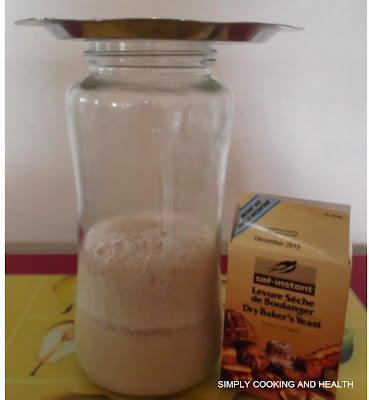
1.      Put yeast and sugar into a long jar or a wide mouth bottle. Add 166 ml of lukewarm water at 100°F   (40 c.). You will get this temperature if you heat the water in a microwave oven for 20 seconds on high.

Yeast beginning to proof


2.      Pour into the yeast and sugar mix. Stir well. Cover and leave it for about 15 to 20 minutes. As the yeast is being activated it will grow and the level will rise. When you see some bubble on top of the jar, it means that the proofing is complete.  If the yeast did not rise, it means something has gone wrong. You will have to discard the mixture and start with a new mixture all over again. Yeast has life in it. If it is active it will proof and rise. Always use a glass, ceramic or stainless steel vessel to proof the yeast. Try not to use an aluminium vessel.


 Yeast beginning to proof Yeast beginning to proof
Yeast mixture ready to maka pizza base
                                  

Preparation of dough
Making the dough by hand   

   1.Heap the flour in a bowl. Make a well in the centre of the heaped flour. Pour the yeast mixture into the flour and add oil and salt.
2. Mix and knead the four well using your hands or a wooden spoon to make a soft and elastic dough.  Roll the soft dough into a ball. Coat the outside of the ball with olive oil. Place the ball into a big greased bowl.
3. Cover the bowl with a wet cloth and keep aside. It will take about 2 hours for the dough to proof.

Making the dough by using the food processor
  1. I prefer to use a food processor to make the dough. Put the 250 grams of flour into the bowl of the processor add salt add oil. Turn the machine on. Do a few pulse for the salt and oil  mix with the flour.
 2. Pour the yeast mixture and run the machine at low speed.You will see the dough rounding up in 2 minutes. Do not put too much flour into the processor.  If you are going to make the dough out of 500 grams of flour, do it in two batches of 250 grams each.
Dough preparation in the food processor


Dough before proofing

3. Remove the dough using your greased hands. Knead the dough well and make it into a ball. Put the dough in a big greased  bowl after coating it with a thin layer of oil.


4.Boil a glass of water for three minutes in the microwave oven. If the glass is tall you can boil it for 5 minutes. Do not remove the glass of water from the microwave oven because we are going to use the heat from the glass of water to proof the dough.
5.  Place the bowl with the dough (uncovered) by the side of the glass and quickly close the door. Let the dough be in the oven for 45 minutes for proofing.
6. Open the door of the Microwave oven only after 45 minutes.  You would see the dough has risen and become twice its original size. Punch the dough and remove it from the bowl using a greased hand. Knead the dough for a minute.You can flip into the bowl two to three times. Roll it again into a ball shape.  Now the dough is ready.
Dough after proofing

7.  Put the dough on a floured board according to the size of your pizza pan. Or you can flatten it round by your palm and press the dough on the greased baking tray, working from the centre to the desired thickness or to cover the entire surface of the tray. Large tray will be 12” in diameter. The thickness will depend on whether you want thick or thin crust pizza.
Flattened dough on the baking tray

8.  Leave it to rise for another 10 minutes.

Dough in the oven
Dough in the oven

9.  Now preheat oven at 210°c for 10 minutes. Place the tray of dough in the oven and bake for about 10-12 minutes and remove.

After 10 minutes of baking

Pizza base is now ready. You can get on with the making of the pizza. You can store the base in the refrigerator for a couple of days or freeze it for a couple of months.

TIPS

Store the dry yeast in the refrigerator. But remove from the fridge and bring it to room temperature before making yeast solution. Always use good yeast. Otherwise it will not proof. If your yeast solution has not proofed well, your pizza base will be hard. The right temperature (40°c) is important in proofing your yeast. You can tell it by the warmth you feel when you insert your finger into the water.

You can also use your oven to proof the dough.  Just preheat the oven at 150°c and switch off the power and leave the bowl of dough in the oven for 45 minutes. The dough is ready.

 
Dough proofing in the oven

We can also wrap the proofed dough with cling foil, put in an air tight container and freeze for future use.


Ivy Fernandeshttps://plus.google.com/1093706883459317135690

Wednesday, 12 March 2014

Phytonutrients

Phytonutrients are organic part of plants, said to enhance human health. Fruits, vegetables, grains, legumes, nuts and teas are rich sources of phytonutrients. Unlike the traditional nutrients (protein, fat, vitamins, minerals), phytonutrients are not "essential" for life, so some people prefer to call them as "phytochemical". Phytonutrients contain disease-preventing compounds. They protect tissues and cells from the harmful effects of free radicals.

Phytonutrients may exist in the thousands; many are yet to be discovered.

Their role in plants is to protect plants from disease, injuries, insects, drought, excessive heat, ultraviolet rays, and poisons or pollutants in the air or soil. They form part of the plants immune system.

If you eat a variety of fresh vegetables and fruits, you should obtain all your requirement of phytonutrients.

Major classes of phytonutrients are:
Carotenoids
Flavonoids (Polyphenols) including Isoflavones (Phytoestrogens)
Inositol Phosphates (Phytates)
Lignans (Phytoestrogens)
Isothiocyanates and Indoles
Phenols and Cyclic Compounds
Saponins
Sulfides and Thiols
Terpenes
Phytosterols or phytohormones

Carotenoids


We probably know more about carotenoids than other phytonutrients. are the red, orange and yellow pigments found in fruits and vegetables. Carotenoids are dominant antioxidants that can help prevent some forms of cancer and heart disease, and can augment your immune response to infections.arotenoids

In humans, four carotenoids (beta-carotene, alpha-carotene, gamma-carotene, and beta-cryptoxanthin) promote vitamin A activity (meaning they can be converted to retinal), and these and other carotenoids can also act as antioxidants.

Retinal is also called retinaldehyde or vitamin A aldehyde, is one of the many forms of vitaminA. Some carotenoids, such as lycopene, do not convert to vitamin A at all, unlike other carotenoids. Lycopene, the orange-red pigment that is found in tomatoes and watermelon, is still of value, because it's an antioxidant that is even more potent than beta-carotene.

Retinaldehyde works on wrinkles and sun damaged skin by exfoliating the cells and encouraging new ones to form. Therefore retinaldehyde is often found in the skin care products.

Carotenoids are divided into:
Alpha-carotene
beta-carotene
beta-cryptoxanthin
lutein
lycopene
zeaxanthin

Alpha-carotene


Alpha-csrotene
Alpha-csrotene


The following vegetables are rich in alpha-carotene:
(1) Yellow-orange vegetables such as carrots, sweet potatoes, pumpkin and winter squash and
(2) Dark-green vegetables such as broccoli, green beans, green peas, spinach, turnips greens, collards and lettuce.
High blood levels of the antioxidant alpha-carotene appear to be associated with a longer life.

Foods rich in alpha-carotene will:
Protect your cells from the damaging effects of free radicals
Provide a source of vitamin A
Enhance the functioning of your immune system
Help your reproductive system function properly.
It is a "provitamin A" compound which means that it can to be converted in the body into retinol, an active form of vitamin A. Alpha-carotene has approximately one-half of the vitamin A activity of beta-carotene.

In addition to their antioxidant and immune-enhancing activity, carotenoids including alpha-carotene have shown the ability to stimulate cell to cell communication. Poor communication between cells may result in the overgrowth of cells leading to cancer. Carotenoids may play a role in the prevention of cancer by establishing proper communication between cells.

Beta-carotene


Beta-carotene is a strongly-coloured red-orange pigment abundant in plants and fruits. It is a natural chemical known as carotenes or carotenoids. Beta carotene is converted to vitamin A in the body. It is an antioxidant, like vitamins E and C.

Beta-carotene is found mainly in dark green and orange-yellow vegetables, such as carrots, sweet potatoes, squash, spinach, broccoli, romaine lettuce, apricots, and green peppers.

Beta-carotene is not considered as an essential nutrient, but vitamin A is.

Some claims of benefits of beta-carotene are:
Prevention of cancer and heart ailment
Slowing of the development of cataracts
Prevention of macular degeneration
Boosting immunity
Protection to the skin from sunburn
Prevention of Asthma
Prevention of Depression
Treatment of Infertility
Prevention of Parkinson’s disease
Prevention of Psoriasis

Beta-cryptoxanthin

Cryptoxanthin is a natural carotenoid pigment. Beta-cryptoxanthin is classified as a pro-vitamin A carotenoid. In the body it can be converted to an active form of vitamin A. Vitamin A is acknowledged as being important for skin and bone health as well as immune function.

Cryptoxanthin is closely related to β-carotene In terms of structure. It is a member of the class of carotenoids known as xanthophylls.

In a pure form, cryptoxanthin is a red crystalline solid with a metallic shine. It  freely dissolves in chloroform, benzene, pyridine, and carbon disulfide.

Food rich in Beta-cryptoxanthin can:
Protect the body cells from the damages caused by free radicals
Provide a source of vitamin A
Reduce the risk of lung cancer and arthritis.

Foods rich in beta-cryptoxanthin are paprika, pepper, red or cayenne chili powder, winter squash, butternut,pumpkin,persimmons, papayas, cloves and tangerines (mandarin oranges)

Beta-cryptoxanthin may also play a role in the prevention of the following health conditions:

Acquired Immunodeficiency Syndrome (AIDS)
Age-related degeneration of muscles
Angina pectoris
Asthma
Cervical dysplasia
Chlamydial infection
Heart disease
Male and female infertility
Photosensitivity
Pneumonia
Vaginal candidiasis

Lutein

Lutein is a carotenoid, meaning a natural colorant or pigment, found in dark green leafy vegetables. It is related to beta-carotene and vitamin A.

Lutein is an antioxidant that reduces the effect of harmful free radicals in various parts of the body. Lutein also filters the high-energy, blue wavelengths of light from the visible-light spectrum by as much as 90%. Blue light, in both indoor lighting and sunlight, is believed to induce oxidative stress and possible free-radical damage in human organs exposed to light, such as the eyes and skin.

Lutein is concentrated in the retinas of your eyes, so it's a necessary component of normal vision. Hence it is often thought as “the eye vitamin.” Some people also use it to prevent colon cancer, breast cancer, type 2 diabetes, and heart disease. It is also believed to reduce the risk of Age Related Macular Degeneration (AMD).

Foods rich in lutein include broccoli, spinach, kale, corn, orange pepper, kiwi fruit, grapes, orange juice, zucchini, and squash. Lutein is absorbed best when it is taken with a high-fat meal.


Lycopene

Lycopene is bright red in colour. It is a carotene and carotenoid pigment. It is also a phytochemical. Although lycopene is chemically a carotene, it has no vitamin A activity. Lycopene is present in human serum and skin as well as the liver, adrenal glands, lungs, prostate and colon.

Lycopene is a powerful antioxidant that can help protect against degenerative diseases. It does this by neutralizing free radicals in the body. It helps in reducing heart disease, cancer and sun burn.

Lycopene found in tomatoes and other red fruits and vegetables, such as red carrots, red bell peppers, pink watermelons, guava, and papayas (but not strawberries or cherries). Lycopene can also be obtained in supplement form. It’s usually sold as tablets or capsules.

The cooking process breaks down the cell walls of the tomato which makes the lycopene more available.

There is no reported evidence of toxicity from taking too much lycopene.

Zeaxanthin


Zeaxanthin plays an essential role in protecting the retina of the eye from the damaging effects of light. Zeaxanthin is very similar to lutein.

Lutein and zeaxanthin are compounds called xanthophylls (ZAN-thuh-fills), which are yellow pigments that occur naturally in many plants and vegetables. Xanthophylls belong to a class of organic compounds called carotenoids, which also includes orange and red plant pigments. Though lutein is considered a yellow pigment, in high concentrations it appears orange-red.

In nature, lutein and zeaxanthin appear to absorb excess light energy to prevent damage to plants from too much sunlight, especially from high-energy light rays called blue light.

The human retina selectively accumulates only two carotenoids: zeaxanthin and lutein.
Lutein and zeaxanthin are found in high concentrations in the macula of the human eye, giving the macula its yellowish colour. Because these carotenoids absorb blue light, and are powerful antioxidants, scientists have hypothesized that they protect the retina.

Age-related macular degeneration (AMD) is a common cause of visual impairment in adults. It affects both eyes. Zeaxanthin reduces the risk factor in AMD. A recent published study found that a nutritional supplement containing meso-zeaxanthin, lutein and zeaxanthin effectively increased the optical density of the macular pigment in eyes of the majority of human subjects. The macular pigment is thought to help in preventing of macular degeneration.

Lutein and zeaxanthin are found in these foods: kale, spinach, collards, turnip greens, green peas, corn, broccoli, romaine lettuce, carrots, green beans and eggs.

Polyphenols

Polyphenols antioxidants and they play an important role in the elimination of free radicals in the body. In addition they prevent heart diseases and cancer. They are anti-inflammatory. Food sources rich in polyphenols include onion, apple, tea, red wine, red grapes, grape juice, strawberries, raspberries, blueberries, cranberries, and walnut.


Phytosterols or phytohormones

These are plant based sterols that act as precursors to human sterols. Precursors are substances the body uses to produce other substances.

These sterols modulate the human endocrine system. Dehydroepiandrosterone (DHEA) is one of the most important human sterols. This hormone is produced in our adrenal glands and serves many functions. It is often called the 'mother' hormone as it has the ability to convert itself into other hormones such as oestrogen, testosterone, progesterone, and corticosterone, on demand. It is a precursor to all other hormones and active metabolites.

Adequate DHEA in the body can slow the aging process. It can prevent or improve, and even reverse conditions such as memory loss, obesity, cancer, heart disease and osteoporosis. The blood level DHEA peak between ages 20 to 25 years and then decline with age in both men and women.

Our body makes stress hormones such as cortisol and adrenaline from DHEA. When our body makes these hormones, DHEA levels decline. The decline in DHEA level causes the development of degenerative diseases mentioned above.

Free radicals

Free radicals are unstable molecules produced in the process of breaking down of food in the body, or when the body is exposed to radiation or contaminants such as tobacco smoke. Excessive production of free radicals can result in oxidative stress known to harm cell membranes and DNA.

Only antioxidants are capable of fighting free radicals. Antioxidant-rich foods may lower the risk of certain chronic diseases, due to the antioxidants' effects on free radicals.