Tuesday, 22 December 2015

Essential Fats


Most people think that fats are bad for health. This is not true. Some fats are good for us while others are bad.  The good fats are called “Essential Fatty Acids” (EFA). There are two EFAs that we need. One is Omega-3 EFA called Alpha-Linolenic Acid (LNA) and the other is Omega 6 called Linoleic Acid (LA). Fatty acids are building blocks of fats. Both EFAs are easily destroyed when exposed to light, air and heat. That is why these fats are stored in coloured glass bottles and not plastic containers..
Salmon
Salmon


These two fatty acids are consumed in a strict proportion of 2 Omega-3 to 1 Omega-6. If this proportion is not maintained one will crowd out the other and it will create a deficiency of the EFA crowded out.
Flax seed
Flax seed

The most abundant food sources of Omega-3 (LNA) are flax seeds. LNA is found in smaller quantities in hemp, canola, soybean, walnuts and dark green leaves. Linoleic acid (Omega-6) is found in safflower, sunflower and corn. It is also found in smaller quantities in soy bean, sesame, pumpkin and almond.


EFAs increase metabolic rate, energy levels and stamina.  Athletes, the elderly, the overweight and middle aged people will feel it more than the others. EFAs do not contribute to weight gain. On the contrary they burn more calories and help you to lose weight. The improve brain function, mood and intelligence. They improve vision, hearing and memory functions. They reduce cardiovascular risks and strengthen the immune system. In diabetics it helps regulate sugar levels and decrease the amount of insulin required. EFAs help in protein metabolism and hemoglobin production.
Olive oil
Olive oil

EFAs can reduce cancer risk and allergic conditions. They help in the proper functioning of liver, kidneys, adrenal and thyroid glands. EFAs have anti-fungal, anti-yeast, and anti-microbial properties. They help in keeping the bones and teeth strong. They strengthen cell membranes.  Oils soften the stools and avoid constipation.  They also improve bowel flora.
virgin coconut oil
 virgin coconut oil


We should consume good fats daily to keep our body healthy. We should aim at getting at least 20% of our energy requirements from good fats.
Avocado
Avocado


 Increasing the fat intake to 50% of the calories will not cause any serious health problems. But this is not practicable. We should maintain a good balance of good carbohydrates, protein and fats to remain healthy and also enjoy a wide variety of tasty food.


Walnut
Walnut


Monday, 21 December 2015

Instant Coconut Sambol


Instant Coconut Sambol
This is an easy to make recipe and can be loved by everyone as it can be eaten with bread, rice, Indian  string hoppers, appam, thosai and idly etc.  Even though we make this with chili powder or paprika powder it is not hot because the coconut takes away the heat from the chili powder. This recipe is not cooked and just assembled with the spices. If you are in a hurry this will be a handy  accompaniment to any bread or starchy food.
Shredded coconut
Shredded coconut


  Recipe summary 
                                              For
                                  Instant Coconut Sambol

Preparation time: 10 minutes
Cooking time: 0

Serves:4

1.Put your gloves on. Mix 150 grams   shredded coconut, 4
grams (2 tsp) chili powder and 2.5 grams (½ tsp) salt well, 
applying slight pressure.

                                      
Ingredients


 2.Add 100 grams (1) onion slice thinly, 2 grams 
Instant Coconut Sambol
 Instant Coconut Sambol
(10) shredded curry leaves and 15 grams (1) green chili seeded and sliced thinly and 58 grams (1 lemon) - juice extracted lime juice and mix well.


 Instant Coconut Sambol is ready.                                


                  Recipe follows in detail with pictures.

Preparation time: 10 minutes
Cooking time: 0
Serves:4

Ingredients

Main
             
150 grams shredded coconut                 
4 grams (2 tsp) chili powder
Others
2.5 grams (½ tsp) salt
58 grams (1 lemon) - juice extracted
100 grams (1) onion slice thinly
2 grams (10) curry leaves
15 grams (1) green chili seeded and sliced thinly
Ingredients for  Instant Coconut Sambol
Ingredients for  Instant Coconut Sambol

Preparation
Chop onion, curry leaves and green chili finely.

Method
Put your gloves on. Mix shredded coconut, chili powder and salt well, applying slight pressure. Add shredded curry leaves and sliced green chili and lime juice and mix well.

That is it. Your sambol is ready.


Nutrition data for this recipe
Nutrition content is computed by adding nutrition values of individual ingredients according to the USDA nutrition database. Water shown here is what is found in the ingredients and not the water added while cooking. This is only an approximation. For further information please read my post “
Nutrition information for my recipes.

This recipe was originally published under 'Coconut sambol'. This post contained 3 recipes. Now I am adding nutrition data to all my recipes in this blog. It became messy to have three nutrition table in one post. So, I am posting this as a separate recipe.
 Click the button below to view the nutrition data. Click again to close it.


Saturday, 19 December 2015

Fats that are harmful

Most of the health problems that we blame on fats are caused by the way the fats are processed. Processing removes all the goodness from the fats – vitamins, protein, fiber, minerals, pytonutrients and many other useful chemical components.

Oils are refined and deodorized. This makes oils look good and smell good. This is important for the sales appeal for the product. It does not matter if the oils loose all the goodness.  The oils that we find in the supermarket shelves are heavily processed. The processed oils are from safflower, sunflower, corn, soy, sesame, canola, peanut etc.

First the oil undergoes a degumming process. The process removes lecithin, complex carbohydrates, chlorophyll, calcium, magnesium, iron and copper. Next the oil undergoes a refining process in which extremely corrosive chemicals such as caustic soda, sodium hydroxide and sodium carbonate are used. This process removes fatty acids and minerals from the oil. The oil is then bleached using Fuller's earth. This process removes chlorophyll and beta carotene from the oil. Finally the oil is deodorized using steam under pressure. This process removes aromatic oils and free fatty acids. This process also removes the pungent odour and unpleasant taste that were not present in the natural oil but were introduced during the tortuous process of refining.

All this processes are merely to create sales appeal on the shelves of the supermarkets. We wonder why so much expense and effort is put to render the oil not desirable for  human consumption.

Scientist made a demon out of the saturated fat. So they came up with a solution by partially hydrogenating the oil. This was proclaimed to be unsaturated fat and therefore good. It was cheap. It could be substituted for butter. So it won the mass appeal. People went crazy about it. Later it was found that the hydrogenated fats were not really unsaturated fats but trans-fats which was more harmful than the saturated fat which it was meant to replace. When these facts came to light people dropped hydrogenated fat like a hot potato. No one buys it anymore. We do not find them in the supermarkets. Their saga is over. Trans-fats were partially hydrogenated. If they were fully hydrogenated they would not be as harmful. Full hydrogenation was expensive so no one undertook it.

Before my time, they extracted oil by crushing the seeds between two wooden objects. The machine was powered by bulls. I still remember the red color of sesame oil extracted by this machine. The oil was full of aroma and you could smell it from far away. People who consumed this were healthy and lived longer. Even in those days there were two types of oil - refined and unrefined. The refined oil was produced from seeds without the skin. And the unrefined oil was produced from the whole seeds. The unrefined oil was more pungent than the refined oil.

Another bane of the fats is from our own folly of deep frying in high heat (above 160 degrees C). The oil subjected to high heat causes cancer and hardening of the arteries. It also contains many toxic substances that are even more toxic than trans-fatty acid.


Deep frying
Deep frying

The excess hard fats are stored as fat deposits in our body. But if we exercised enough we could use a lot of hard fats as energy. We will then remain healthy.

Saturday, 12 December 2015

Calabash with cabbage and mung bean

Calabash is an African and Asian vegetable. Calabash ( Bottle gourd) is one of the oldest vegetable known to man. Hence it was used to treat all kinds of ailments. Calabash is rich in Vitamin B1 and C. It also contains calcium, iron, sodium and potassium.


Calabash with cabbage and mung bean
Mung beans is high in protein and fiber. It has A, B Vitamins (Thiamine, Riboflavin, Folic Acid, Niacin, Vitamin B6, Pantothenic Acid) Vitamin E, Vitamin D, Vitamin C, Vitamin K.


 Recipe summary
                                                for
                     Calabash with cabbage and mung bean

Preparation time: 20 minutes
Cooking time: 30 minutes

Serves: 6


1. Dry roast 100 grams  split mung beans.Put it in a pan add enough water to cover the mung beans.Bring to boil and simmer for 15 minutes.Set aside.


Calabash with cabbage 
and mung bean 

2. Heat up 12.6 gram vegetable oil (1 table spoon)oil in a pan. Reduce heat to low and add 2 grams mustard seeds (1 teaspoon). Wait till the mustard seeds splutter. Add 1 gram dry chili, broken into small pieces (1) and fry for 30 seconds.   Add 50 grams of onion (half the quantity), half the curry leaves from 1 sprig and fry for 10 minutes or till the onions take a golden colour. Remove the fried ingredients from the pan and set aside.
Ingredients


3.In a medium sized pan add cooked mung beans. 500 grams calabash peeled and sliced into bite size pieces,100 grams cabbage, sliced into bite size pieces,  remaining 50 grams onion, remaining curry leaves, 15 grams green chili (1)
3 gram pandan leaf (3" x 3 pieces),9 grams garlic (3 cloves)2.5 grams salt (1/2 teaspoon)1.05 gram cumin seeds (1/2 teaspoon)
1.5 gram fennel seeds (1/2 teaspoon), 2 gram pepper powder (1/2 teaspoon) and 1.5 gram turmeric powder and 1 litre water. Bring to boil and let it simmer for 15 minutes
Ingredients for tempering

4. Add 226 grams coconut milk ( 1 cup). Continue to cook for 3 minutes uncovered.


5. Add the fried ingredients that were set aside earlier. You can also serve the curry without the fried ingredients

        Calabash with cabbage and mung bean curry is ready.
                                  
       
                       Recipe follows in detail with pictures.


Preparation time:
 20 minutes
Cooking time: 30 minutes
Serves: 6
Ingredients
Main
500 grams calabash peeled and sliced into bite size pieces.
100 grams cabbage, sliced into bite size pieces
100 grams mung beans split
Ingredients for Calabash with cabbage and mung bean
Ingredients for Calabash with cabbage and mung bean 

Others
nion,garlic,curry leaf,red and green chili, pandan leaf
Onion,garlic,curry leaf,red and green chili, pandan leaf
100 grams onion (1)
9 grams garlic (3 cloves)
15 grams green chili (1)
3 gram pandan leaf (3" x 3 pieces)
1 gram curry leaves (1 sprig)
12.6 gram vegetable oil (1 table spoon)
226 grams coconut milk ( 1 cup)
2.5 grams salt (1/2 teaspoon)
1 litre water

Spices
1 gram dry chili, broken into small pieces (1)
2 grams mustard seeds (1 teaspoon)
1.05 gram cumin seeds (1/2 teaspoon)
1.5 gram fennel seeds (1/2 teaspoon)
2 gram pepper powder (1/2 teaspoon)
1.5 gram turmeric powder
Ingredients for tempering

Preparation
Dry roast the mung bean seeds in a pan or wok. I did in microwave for 2 minutes on high.
In a pan add the mung beans and enough water to cover the mung beans.
Bring to the boil and let it simmer for 15 minutes covered.
Take the pan off the fire. Drain the mung beans and set aside.

Method
In a medium sized pan add the oil and heat it up. When the oil is hot reduce the heat to low and add mustard. Wait till the mustard seeds splutter.
Frying mustard seeds
Add dry chili pieces and fry for 30 seconds.
Frying dry chili with mustard
Add 50 grams of onion (half the quantity), half the curry leaves and fry for 10 minutes or till the onions take a golden colour.
Frying onion and curry leaves
Remove the fried ingredients from the pan and set aside.

In a medium sized pan add cooked mung beans.
Add calabash, cabbage, remaining onion, remaining curry leaves, green chili, red chili, garlic, pandan leaves, salt, cumin seeds, fennel seeds pepper powder and turmeric powder.


Calabash with all the ingredients
Cover the pan and let it simmer for 10 minutes.
Simmering calabash
 Simmering calabash
The mung bean and the calabash will be very soft now. Mung bean will be slightly dissolved.
Add coconut milk.
Adding coconut milk
Adding coconut milk
Continue to cook for 3 minutes uncovered.
Add the fried ingredients that were set aside earlier. You can also serve the curry without the fried ingredients
Adding the fried ingredients to the curry
Calabash with cabbage and mung bean is ready to be served.


Calabash with cabbage and mung bean
                                                 Calabash with cabbage and mung bean 


 Nutrition data for this recipe
Nutrition content is computed by adding nutrition values of individual ingredients according to the USDA nutrition database. Water shown here is what is found in the ingredients and not the water added while cooking. This is only an approximation. For further information please read my post “Nutrition information for my recipes.
 Click the button below to view the nutrition data. Click again to close it.
Calabash with cabbage and mung bean
NutrientValue
Unit

Water
852.3
g
Energy
1,081.3
kcal

Protein
35.8
g

Total lipid (fat)
63.6
g

Carbohydrate, by difference
108.1
g

Fiber, total dietary
24.5
g

Sugars, total
15.2
g

Calcium, Ca
414.7
mg

Iron, Fe
17.9
mg

Magnesium, Mg
392.1
mg

Phosphorus, P
754.0
mg

Potassium, K
2,987.4
mg

Sodium, Na
1,066.9
mg

Zinc, Zn
8.2
mg

Vitamin C, total ascorbic acid
141.4
mg

Thiamin
1.0
mg

Riboflavin
0.5
mg

Niacin
6.2
mg

Vitamin B-6
1.1
mg

Folate, DFE
756.6
µg

Vitamin B-12
0.0
µg

Vitamin A, RAE
35.4
µg

Vitamin A, IU
782.1
IU

Vitamin E (alpha-tocopherol)
6.5
mg

Vitamin D (D2 + D3)
0.0
µg

Vitamin D
0.0
IU

Vitamin K (phylloquinone)
89.8
µg

Fatty acids, total saturated
44.6
g

Fatty acids, total monounsaturated
5.4
g

Fatty acids, total polyunsaturated
9.7
g

Cholesterol
0.0
mg

Caffeine
0.0
mg

Fatty acids, total trans
0.0
g

Ash
11.7
g

Copper, Cu
1.7
mg

Manganese, Mn
3.8
mg

Selenium, if
15.8
µg

Folate, total
756.6
µg

Folic acid
0.9
µg

Folate, food
756.6
µg

Retinol
0.0
µg

Wednesday, 9 December 2015

Easy oil free spicy potato curry


We use oil in curries to temper the spices. When we stir-fry we consume all of the oil used. Over time this can get accumulated. I am trying this recipe to lessen the amount of oil we consume.  Coconut milk is used. It consists mostly of oil. It is difficult to make a curry totally oil free.
Easy oil free spicy potato curry


                                  Recipe summary
                                                 For
                            Easy oil free spicy potato curry

Preparation time:15 minutes

Cooking time: 30 minutes
Serves: 4


1. In a large pan add 500 grams potatoes cut into bite size pieces,
100 grams onion, chopped coarsely, 1 gram curry leaves, 
Potatoes,onion,chili,garlic,ginger,pandan leaf and curry leaves
Potatoes,onion,chili,garlic,ginger,
pandan leaf and curry leaves

chopped, 9 grams garlic (3 cloves) sliced, 15 grams green chili. Sliced into small pieces, 10 grams ginger, grated, 30 grams pandan leaf pieces. 


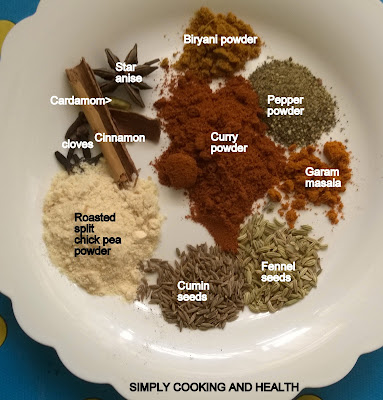
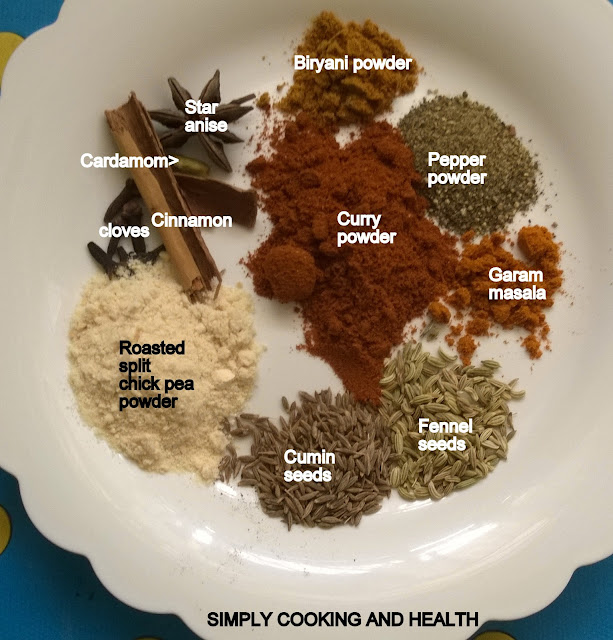
Spice and spice powders
2. Add all the spices;12.5 grams roasted chickpea powder, 1.05 gram cumin powder (1/2 teaspoon),1.5 gram fennel seeds (1/2 teaspoon), 1 gram garam masala powder (1/4 teaspoon), 2 gram pepper powder (1/2 teaspoon),2 grams briyani powder, 0.5 gram cloves (5 pieces), 2 grams star anise seed (1 piece), 2 grams cinnamon (1 piece) except curry powder.


Easy oil free spicy potato curry

2. Add 500 ml water 2.5 grams salt (1/2 teaspoon) and 6.3 gram curry powder (1 tablespoon).


3.Bring to the boil. Lower the heat to medium. Cover the pan and simmer for 25 minutes.


4. Add 113 grams coconut milk (1/cup). Simmer uncovered for  3 minutes.
   
               Easy oil free spicy potato curry is ready.
                      Recipe follows in detail with pictures.


Preparation time:15 minutes
Cooking time: 30 minutes
Serves: 4


Ingredients
main
500 grams potatoes cut into bite size pieces
Others
100 grams onion, chopped coarsely
1 gram curry leaves, chopped
9 grams garlic (3 cloves), sliced
15 grams green chili. Sliced into small pieces
10 grams ginger, grated
30 grams pandan leaf pieces


Spices
12.5 grams roasted chickpea powder
1.05 gram cumin powder (1/teaspoon)
1.5 gram fennel seeds (1/teaspoon)
1 gram garam masala powder (1/teaspoon)
Spice and spice powders
2 gram pepper powder (1/teaspoon)
2 grams briyani powder ( 1 / 2 teaspoon)
6.3 gram curry powder (1 tablespoon)
0.5 gram cloves (5 pieces)
2 grams star anise seed (1 piece)
2 grams cinnamon (1 piece)


Others
113 grams coconut milk (1/cup)
500 ml water
2.5 grams salt (1/teaspoon)


Preparation
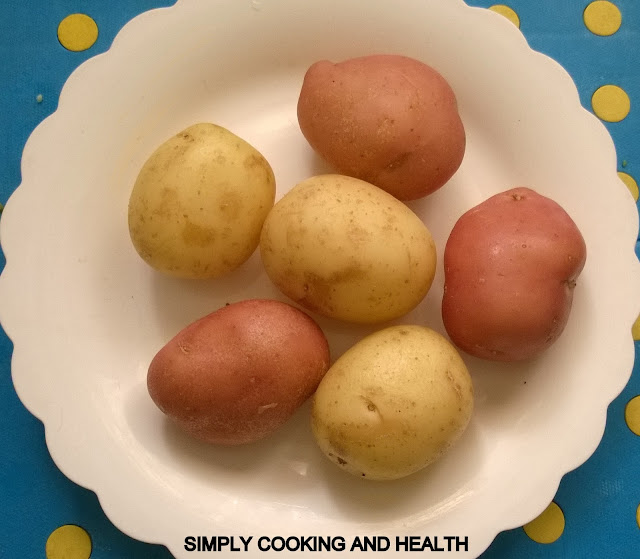
Wash and cut the potatoes. I cut with the skin on as I used machine washed potatoes. I used red and white potatoes.
Potatoes
Potatoes

Cut all the other ingredients

Potatoes,onion,chili,garlic,ginger,pandan leaf and curry leaves

Method
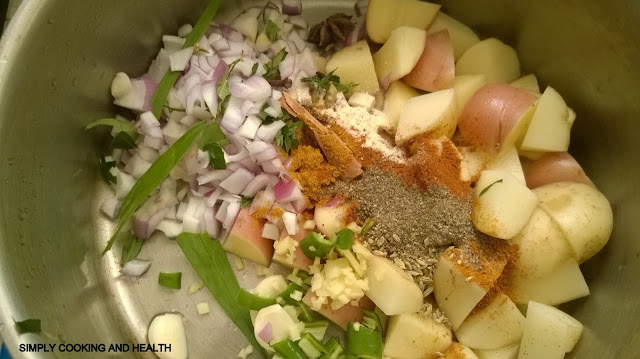
In a large pan add potatoes, onion, curry leaves, garlic, green chili, ginger and pandan leaves. Add all the spices except curry powder.
All ingredients have been added in the pot


Add the water and curry powder
Water, curry powder and salt
Bring to the boil. Lower the heat to medium. Cover the pan and simmer for 25 minutes.
Add coconut milk. Simmer uncovered for 3 minutes.
Adding coconut milk
Adding coconut milk
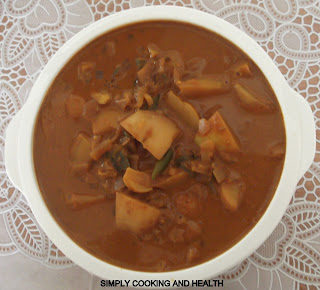
The curry is ready. There is a lot of gravy. You can reduce the amount of curry powder if  you want the curry to be mild.


Easy oil free spicy potato curry


Nutrition data for this recipe
Nutrition content is computed by adding nutrition values of individual ingredients according to the USDA nutrition database. Water shown here is what is found in the ingredients and not the water added while cooking. This is only an approximation. For further information please read my post “
Nutrition information for my recipes.

 Click the button below to view the nutrition data. Click again to close it.


Easy oil free potato curry

Nutrient
Value
Unit
Water
515.8
g
Energy
558.4
kcal
Protein
17.2
g
Total lipid (fat)
3.5
g
Carbohydrate, by difference
121.6
g
Fiber, total dietary
20.8
g
Sugars, total
10.8
g
Calcium, Ca
234.9
mg
Iron, Fe
9.3
mg
Magnesium, Mg
201.0
mg
Phosphorus, P
430.6
mg
Potassium, K
2,725.6
mg
Sodium, Na
56.2
mg
Zinc, Zn
2.9
mg
Vitamin C, total ascorbic acid
147.7
mg
Thiamin
0.6
mg
Riboflavin
0.3
mg
Niacin
6.4
mg
Vitamin B-6
1.9
mg
Folate, DFE
169.1
µg
Vitamin B-12
0.0
µg
Vitamin A, RAE
14.4
µg
Vitamin A, IU
301.9
IU
Vitamin E (alpha-tocopherol)
1.9
mg
Vitamin D (D2 + D3)
0.0
µg
Vitamin D
0.0
IU
Vitamin K (phylloquinone)
24.9
µg
Fatty acids, total saturated
0.6
g
Fatty acids, total monounsaturated
1.0
g
Fatty acids, total polyunsaturated
1.0
g
Cholesterol
0.0
mg
Caffeine
0.0
mg
Fatty acids, total trans
0.0
g
Ash
7.4
g
Copper, Cu
0.9
mg
Manganese, Mn
3.6
mg
Selenium, if
6.1
µg
Folate, total
169.1
µg
Folic acid
0.9
µg
Folate, food
169.1
µg
Retinol
0.0
µg